 General Guidelines
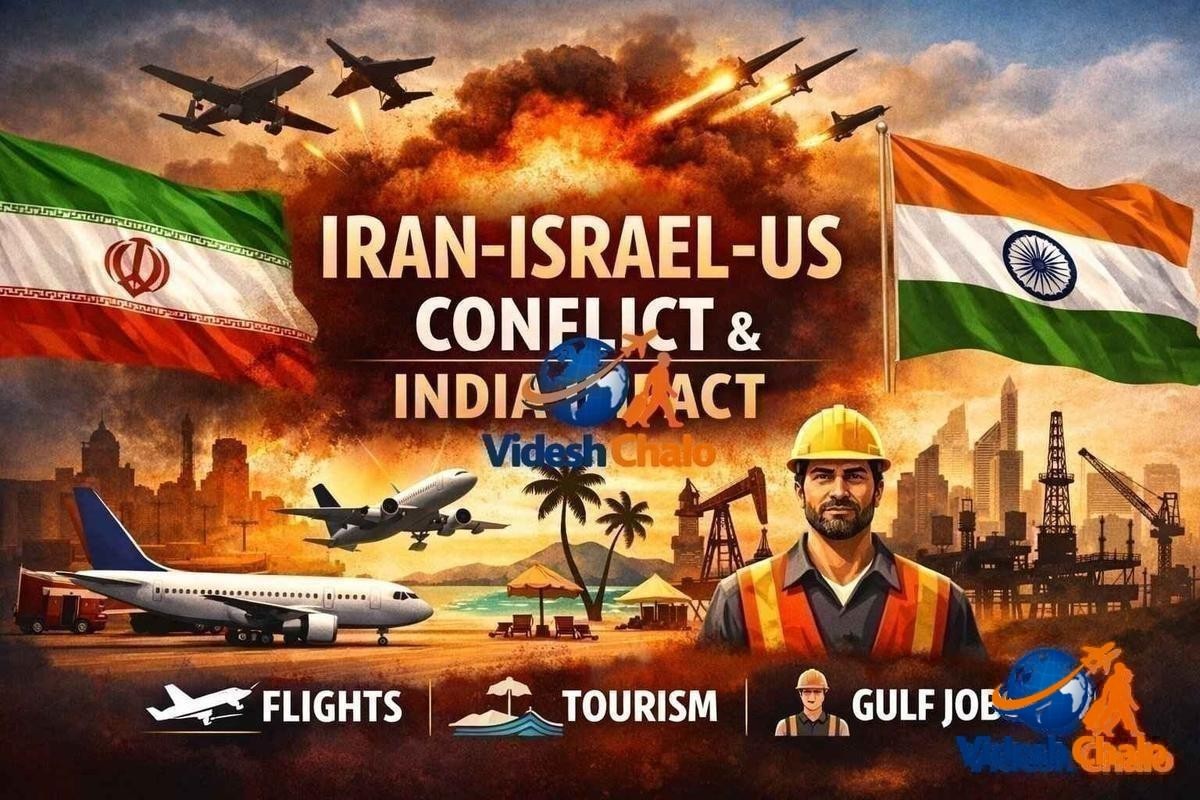
How the Iran–Israel–US Conflict Could Affect India: Flights, Tourism, and Jobs Explained
📌 Show Quick Read
Summary is AI-generated, Videsh Chalo-reviewed
- The Iran–Israel–US conflict is disrupting India’s aviation, tourism, and overseas jobs.
- Flight cancellations, rising fuel costs, and longer travel times are hitting passengers hard.
- Over 9 million Indian workers in the Gulf face uncertainty, affecting crucial remittances.
🌍 Introduction: Why This Conflict Matters for India
The conflict involving Iran, Israel, and the United States may be happening thousands of kilometres away, but its effects are already reaching India.
In today’s highly connected global economy, a conflict in one region can quickly affect:
-
✈️ International flights
-
💼 Jobs abroad
-
🛢️ Oil prices
-
🌍 Tourism and global trade
For India, West Asia (Middle East) is extremely important. Millions of Indians work in countries such as:
-
 United Arab Emirates
  Saudi Arabia
 Qatar
Qatar Kuwait
 Oman
Oman
Every week, hundreds of flights pass through Gulf airspace connecting India to Europe, North America, and Africa.
⚠️ As tensions increase in the region, disruptions are starting to appear in aviation, tourism, and overseas jobs for Indians.
Let’s understand what is happening and how it could affect India.
✈️ 1. Aviation Sector Facing Major Disruptions
🌐 Why aviation is the first industry affected
Whenever geopolitical conflicts happen, aviation is usually the first sector to feel the shock.
The Middle East acts as a major global air corridor connecting the following:
-
Asia
-
Europe
-
North America
If tensions rise in this region, airlines must avoid certain airspaces, forcing them to change flight routes.
❌ Flight cancellations and disruptions
Due to the conflict:
-
✈️ 357 international flights were cancelled in a single day
-
📉 1,100+ flights cancelled within three days
-
👥 Thousands of passengers affected
Major airlines impacted include:
-
IndiGo
-
Air India
-
Air India Express
-
SpiceJet
-
Akasa Air
Flights to several Middle Eastern cities were also affected, including:
-
Abu Dhabi
-
Doha
-
Jeddah
-
Kuwait
-
Riyadh
⚠️ Why airlines are changing routes
When conflict makes airspace unsafe:
-
✈️ Airlines reroute flights
-
⏱️ Travel time becomes longer
-
⛽ Fuel consumption increases
-
💸 Airline operating costs rise
This creates a chain reaction across the aviation industry.
😟 What travellers may experience
Passengers could face several problems such as:
-
⏳ Flight delays
-
❌ Flight cancellations
-
🔁 Route changes
-
💰 Higher ticket prices
-
⌛ Longer travel time
👉 Tip: Always check your flight status before leaving for the airport if you are traveling through Gulf hubs.
⛽ 2. Rising Fuel Prices Could Make Flights More Expensive
Another major concern is oil prices.
Airlines rely heavily on Aviation Turbine Fuel (ATF), which makes up about
📊 25–35% of airline operating costs
If conflicts disrupt oil supply in the Middle East, fuel prices can increase globally.
💰 Possible impact on travellers
This may lead to:
-
📈 Higher international airfares
-
📉 Reduced flight frequency
-
✈️ Expensive long-distance travel
Even airlines not flying over the Middle East may feel the impact because fuel prices are global.
🧳 3. Tourism Industry Could Slow Down
Tourism is another sector that reacts quickly to geopolitical tensions.
Many Indian travelers fly to Europe or North America via Gulf transit hubs like
-
🌆 Dubai
-
🌆 Doha
-
🌆 Abu Dhabi
If these routes become risky or complicated, people often delay their travel plans.
📉 Possible tourism impacts
Travel companies may see:
-
🧳 Delayed vacations
-
👨👩👧👦 Cancelled group tours
-
🛡️ Higher travel insurance costs
-
📉 Reduced bookings
During conflicts, safety perception strongly influences travel decisions.
🌏 Travel patterns may change
Instead of travelling to conflict-affected regions, tourists may prefer the following:
-
🌴 Southeast Asia
-
 Domestic tourism in India
 -
🏝️ Short-distance international trips
This shift could impact airlines, hotels, and travel agencies worldwide.
👷 4. Indian Workers in the Gulf May Feel the Pressure
One of the most sensitive impacts of the conflict involves Indian workers in Gulf countries.
More than 9 million Indians live and work in West Asia.
They mainly work in sectors such as the following:
-
🏗️ Construction
-
🏥 Healthcare
-
🛍️ Retail
-
🏨 Hospitality
-
🚚 Logistics
😟 Why workers are worried
Even if Gulf countries are not directly involved in the war, tensions create uncertainty.
Workers may worry about:
-
📉 Job slowdowns
-
💰 Salary delays
-
📄 Visa issues
-
🏗️ Project cancellations
-
✈️ Emergency evacuation situations
This situation can also cause financial stress and psychological anxiety for workers and their families.
💵 5. Gulf Remittances Are Crucial for India
Indian workers abroad send huge amounts of money back home every year.
According to financial data:
-
💰 India received $135 billion in remittances in 2024-25
-
🌍 38% came from Gulf countries
-
Nearly half came from the UAE
🏠 How this money supports India
Remittances help families with:
-
🎓 Education
-
🏥 Healthcare
-
🏠 Real estate
-
🧾 Household expenses
If jobs slow down in the Gulf, many Indian families could feel the financial impact.
🏭 6. Other Industries That Could Be Affected
The conflict doesn’t only affect flights and tourism. Many industries depend on oil and global trade routes.
Sectors likely to feel pressure
-
✈️ Aviation
-
🧳 Tourism
-
🏨 Hospitality
-
🧾 Travel agencies
-
🚢 Shipping and logistics
-
🌐 International trade
🧴 Everyday products could become expensive
Petroleum products are used in manufacturing many items, such as:
-
🧼 Soaps
-
🧴 Shampoos
-
💄 Cosmetics
-
🎨 Paints
-
🧴 Plastics
If oil prices rise:
-
🏭 Production costs increase
-
💰 Companies may raise prices
This could impact FMCG and manufacturing industries in India.
🔋 7. Energy Markets Could Become Unstable
Energy markets are extremely sensitive to conflicts in the Middle East.
Possible impacts include:
-
📈 Natural gas price spikes
-
⚡ LNG supply disruptions
-
📊 Energy market volatility
Higher energy prices can eventually affect:
-
Electricity bills
-
Transportation costs
-
Manufacturing expenses
🏛️ 8. India’s Diplomatic Strategy
India has historically maintained balanced relations in West Asia.
The country maintains strong ties with:
-
Israel
-
Iran
-
Gulf nations
This balanced approach helps India protect its interests during crises.
📢 Possible government actions
Authorities usually focus on:
-
✈️ Monitoring aviation safety
-
📢 Issuing travel advisories
-
🧍 Helping stranded passengers
-
👷 Supporting Indian workers abroad
-
🚨 Preparing evacuation plans
Indian embassies may also activate the following:
-
☎️ Emergency helplines
-
🏢 Consular assistance
-
📢 Official advisories
Clear communication helps avoid panic and misinformation.
🔮 9. What Could Happen Next?
The future impact depends on how the conflict evolves.
✅ If tensions decrease
-
✈️ Flights return to normal
-
🧳 Tourism recovers
-
⛽ Oil prices stabilize.
⚠️ If tensions escalate
-
❌ More flight disruptions
-
📈 Higher fuel prices
-
😟 Travel uncertainty
-
👷 Pressure on Gulf jobs
In a globalized world, even distant conflicts can quickly affect economies and daily life.
🧾 Conclusion
The Iran–Israel–US conflict may be happening far from India, but its ripple effects are already visible.
From flight cancellations and rising ticket prices to concerns among Indian workers in the Gulf, the situation highlights how interconnected the modern world has become.
For now, uncertainty remains the biggest challenge.
✔ Travellers should stay updated with airline advisories.
✔ Indian workers abroad should stay connected with their embassies.
✔ Governments and businesses must stay prepared.
🌍 In today’s world, global conflicts rarely stay local — their impact travels fast.
Videsh Jane Ka Sapna Sach Karein! ✈️
Bhai, sirf jankari kafi nahi hai. Aaj hi apni profile update karein aur top companies mein apply karein.